
Org Unit
Emergency Management (EOC)
The Mat-Su Borough EOC is currently activated at Type 3-A Incident Activation Level.
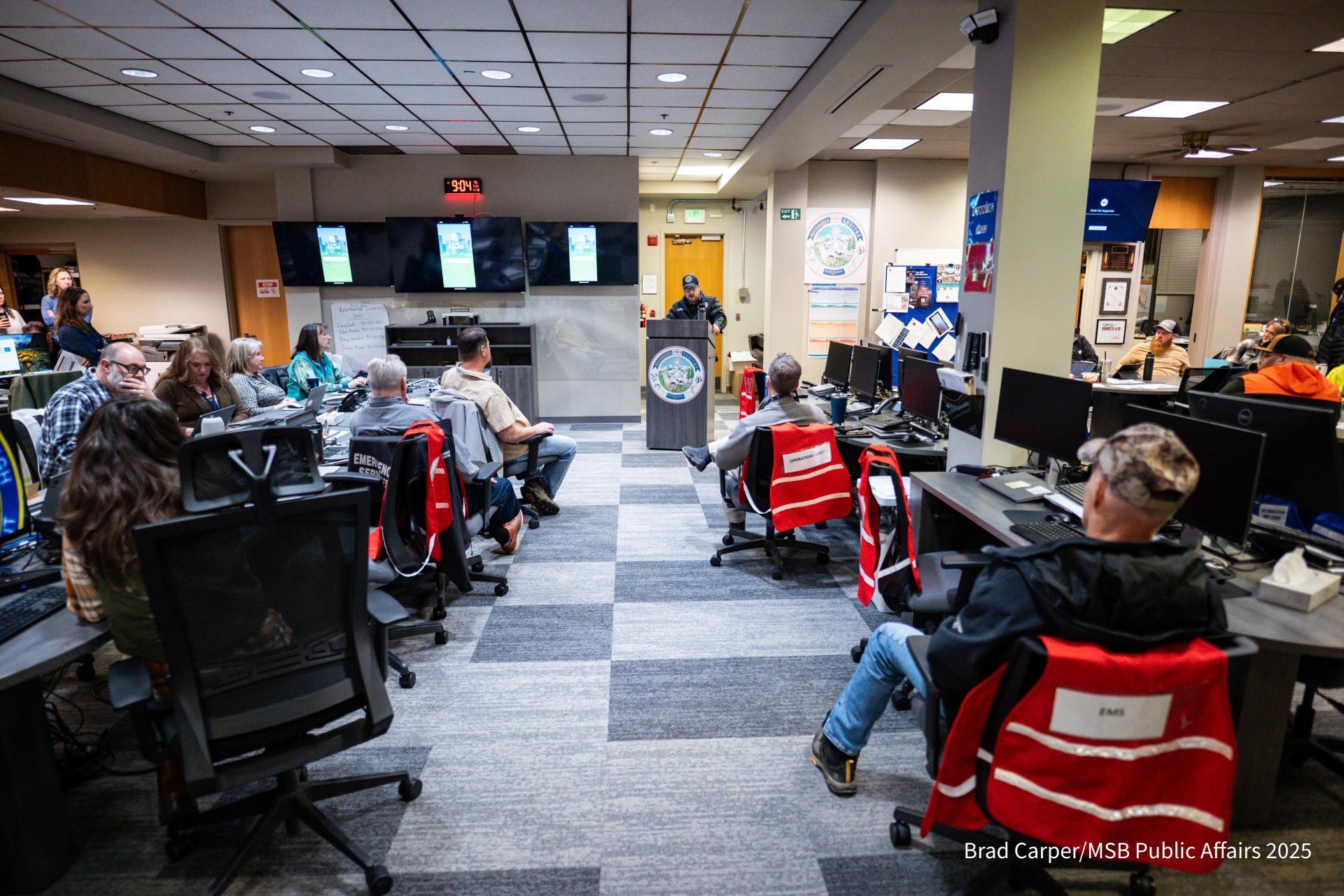
Mat-Su Borough has an Emergency Management team running a world class Emergency Operations Center (EOC). This team is responsible for all large scale planning, preparedness, response and recovery operations in the MSB. These duties include preparedness grants, preparedness activities and outreach to the community, as well as emergency telecommunications and E911, Community Emergency Response Teams (CERT), and the Local Emergency Planning Committee (LEPC). A major portion of this responsibility is the staffing and operations of the Emergency Operations Center, and the training required for DES, MSB and partnering agency employees to be able to staff an efficient and professional EOC when needed. EOC operations includes, but is not limited to, mass notification, incident planning and coordination, logistics, finance, purchasing, documentation and liaising with partnering agencies throughout the MSB and the State. Major disaster recovery is also managed out of the EOC to include multiple state and federal open Presidentially declared disasters currently. This involves working as the recovery chair and collaborating with MSB project managers and internal customers, the State of Alaska, FEMA and other Federal agencies, to repair or rebuild schools, roads, bridges, etc., and all the required paperwork and programmatic needs in order to recover and receive reimbursements for those disaster projects. The EM team is also the first point of contact for individual MSB residents in dealing with disasters after being declared by the State.
The Emergency Manager is assisted by a skilled and dedicated team of 2 full time Emergency Telecom staff and 13 part time EOC Specialists, each with specific areas of expertise. It takes all of this hard-working team to keep our Borough functioning and providing essential services, even during times of widespread disaster.
For general questions about applying for a position with Emergency Services, contact Human Resources at 907-861-8404.
EMERGENCY MANAGEMENT
Emergency information provided by the Mat-Su Borough Emergency Management staff, including wildfire status, road closures due to flooding, shelters, and evacuation zones.
MSB OEM
Matanuska-Susitna Borough Office of Emergency Management (MSB OEM) has the responsibility of preparing for, responding to, recovering from, and mitigating against large-scale emergencies and disasters that impact the Mat-Su Borough. MSB OEM works in partnership with first responders, private sector, Tribal, and government agencies to build community resiliency.
MSB EOC
The Matanuska-Susitna Borough Emergency Operations Center (EOC) is a state-of-the-art facility designed to provide a centralized location for multi-agency coordination and facilitation of emergency disaster response and recovery efforts. While tactical efforts are conducted in the field from Incident Command Posts (ICP), the MSB EOC is typically activated during emergencies when resources exceed local capabilities or incidents are of longer durations, or when policy decisions need conducted or when a disaster declaration is declared.
MSB EOC TELECOMS
Matanuska-Susitna Borough EOC Telecoms is the communications branch of the Mat-Su Borough. The focus is to provide, maintain, enhance, and develop vital emergency communications to Mat-Su Borough Emergency Fire and EMS responders and personnel in support of day-to-day operations, emergency disasters, disaster mitigation, large-scale MSB events, and training. MSB EOC Telecoms is responsible for the radio communications infrastructure, site management, maintenance and expansion of communication services for Public Safety to include support of MSB Solid Waste, MSB Operations & Maintenance, MSB Animal Care and MSB Port operations.
PUBLIC INFORMATION ALERT & WARNING
Mat-Su Borough OEM provides public information, emergency alert and warning notifications to the public through phone, television and internet services. Notifications may include type of hazard followed by guidance and direction before, during and after incidents occur. Notifications are provided to the public without having to register for the services.
OPERATIONS SECTION
TYPES OF DISASTER INCIDENTS THAT CAN OCCUR IN THE MAT-SU BOROUGH
Avalanches
Cyber-security Attacks
Earthquakes Erosions/Floods/Landslides
Extreme Weather Events
Hazardous Materials Incidents
Pandemics
Power Outages/Energy Shortages
Terrorism/WMD Incidents
Transportation Accidents
Tsunamis
Volcanic Eruptions
Wildfires
MATANUSKA-SUSITNA BOROUGH EMERGENCY OPERATIONS CENTER ACTIVATION LEVELS
Type 5 Incident Activation
Mat-Su Borough is conducting normal daily operations with local resources, policies, and procedures. The incident can be managed with resources initially dispatched to the scene. The incident can be contained within the first operational period, and often within a few hours of resources arriving on scene. No incident action plan (IAP) is required. Current conditions are being monitored by emergency management staff. Incident examples may include a vehicle fire, injured person(s) or a police traffic stop.
Type 4 Incident Activation
Mat-Su Borough is conducting normal daily operations with local resources, policies, and procedures. The incident may require additional local resources (mutual aid) dispatched to the scene. The incident is usually limited to one operational period. No incident action plan (IAP) is required but operational briefings and resource orders should be documented. Current conditions are being monitored by emergency management staff. Incident examples may include hazardous materials (HAZMAT) spill on a roadway or waterway, a large commercial fire, or localized flooding event affecting a neighborhood or subdivision.
Type 3A Incident Activation
An incident has developed requiring partial or full activation of the MSB EOC. The incident is limited to a single location where specialized resources and/or assistance is required. A disaster declaration has not been requested of issued. Typical MSB EOC staffing may include Emergency Manager, Situation Unit Leader, Resource Unit Leader, Logistics Section Chief, and Public Information Officer. Incident examples may include a transportation accident or cyber-security attack.
Type 3B Incident Activation
An incident has developed requiring partial or full activation of the MSB EOC. The incident is limited to a single location where resource requests exceed the capability to complete in a timely manner. The incident affects several citizens. A disaster declaration has not been requested or issued. Typical MSB EOC staffing may include Emergency Manager, Situation Unit Leader, Resource Unit Leader, Logistics Section Chief, Finance Section Chief and Public Information Officer. Incident examples may include power outage/energy shortage, extreme local weather event, or landslide.
Type 3C Incident Activation
The incident is rapidly expanding, requiring resources exceeding those available within the immediate and adjacent service areas. The incident affects numerous citizens or impacts critical infrastructure. Multiple operational periods are expected. a disaster declaration has or is expected to be issued. Typical MSB EOC staffing will include all Command and General staff positions and less than 200 operations personnel including first responders. An Incident Action Plan (IAP) is developed. Incident examples may include large earthquakes, flooding, or localized ash fall from a volcanic eruption.
Type 2 Incident Activation
The incident exceeds local capabilities to manage. A disaster declaration has been issued or control of the incident has been passed to another, such as Alaska Division of Forestry. Twenty-four-hour around-the-clock operational periods have been established. Typical MSB EOC staffing will include all Command and General staff positions. Staffing typically does not exceed 500 operational personnel including first responders. The incident may include multiple regions and/or jurisdictions. Incident examples may include a wildland fire or widespread flooding across an entire region.
Type 1 Incident Activation
A major incident has occurred where extensive resources required exceed the ability of a Type 2 Incident Management Team requiring 500 operational personnel and can exceed 1000 total personnel. Typical MSB EOC staffing will include all Command and General staff positions. Incident examples may include pandemics, or a large-scale wildfire affecting several regions and jurisdictions.
PLANNING SECTION
SITUATIONAL AWARENESS
During emergency incidents, MSB OEM provides situational reports to community stakeholders. These situational reports include status of community lifelines. Community lifelines are critical government and business functions that are essential to human health, safety and security. They may include but not limited to the energy power grid, water systems, communications infrastructure, health and medical facilities, agriculture, supply chain and transportation infrastructure, and safety and security services.
EMERGENCY PLANS
Mat-Su Borough OEM develops and maintains emergency plans related to preparedness, response, recovery and mitigation efforts. These plans are updated on a regular basis and include the following:
Emergency Operations Plans (EOP)- Used in preparedness efforts to facilitate what the Borough will do for a disaster. These plans identify the overall authority, roles and functions. Incident
Action Plans (IAP)- Created after an event has occurred. These plans identify the objectives and tactics (what and how) the Borough will do to respond to a disaster once an event has occurred. These plans prioritize life safety, protection of property and protection of the environment.
Continuity of Operations Plans (COOP)- Created to identify how the Borough will maintain its day-to-day operations in the event an incident effects the location(s) of Borough facilities and/or staff.
Threat and Hazard Identification & Risk Assessment (THIRA)- Is a risk assessment analysis conducted to identify potential risks the Mat-Su Borough may face, measure Mat-Su Borough's capabilities to respond to these risks, identify potential gaps in capabilities and identify means to close these potential gaps. These assessments are used to facilitate mitigation practices.
Memorandums of Understanding/Memorandums of Agreement (MOU/MOA)- Written agreed upon partnerships between the Mat-Su Borough and community stakeholders to build community resiliency during the disaster recovery process.
LOGISTICS SECTION
MEDICAL COUNTERMEASURES (MCM)
Medical Countermeasures are products used in public health emergencies resulting from terrorist attacks with a biological, chemical or radiological material or a naturally occurring disease. These products are used in preventing, mitigating and or treating adverse health effects and are critical in minimizing mortality in large-scale public health emergencies.
POINTS OF DISTRIBUTION (PODS) & COMMODITIES POINTS OF DISTRIBUTION (C-PODS)
Mat-Su Borough coordinates with the State of Alaska Department of Health and Social Services (DHSS) in developing plans for managing and dispensing the Strategic National Stockpile in accordance with the United States Center for Disease Control and Prevention (CDC) guidance.
RECOVERY SECTION
DISASTER DECLARATIONS
Because disasters occur locally and the effects of these disasters impact local communities, the responsibility to respond and recover to these disasters lies with the Mat-Su Borough. Because of this we say disasters begin and end locally. The advantage is the local communities, and the Mat-Su Borough are familiar with its own geography, social and economic needs of its residents. When the Mat-Su Borough exceeds its capabilities, a disaster declaration can be submitted to the state and federal government to request additional support and resources. If the request is approved and additional support and resources are provided, Mat-Su Borough maintains control of these resources provided in the response and recovery efforts until a sense of normalcy can be restored to the community.
LOCAL, STATE, & FEDERAL DISASTER DECLARATION PROCESS
Step 1: An incident occurs.
Step 2: Local government responds to the incident.
Step 3: If the local government exceeds its capabilities to respond, the local government can submit a formal request (usually in writing) for assistance (State Disaster Declaration) to the Governor through Alaska Division of Homeland Security & Emergency Management (AK DHS & EM). When the request is made, a preliminary damage assessment (PDA) is completed to determine the loss and recovery needs. AK DHS & EM then makes a recommendation to the Governor.
Step 4: The Governor approves or denies the request for assistance.
Step 5: If the State government believes it will exceed its capabilities to assist the local government, the Governor can submit a formal request for assistance (Presidential Disaster Declaration) to the President through FEMA.
Step 6: FEMA reviews the request and sends a recommendation to the President for a decision.
Step 7: President approves or denies the request for assistance.
INDIVIDUAL ASSISTANCE (IA)
When declarations are declared, Individual Assistance (IA) may be provided to disaster survivors to assist them and their families when serious loss of property has occurred that has not been covered by their insurance. This may include lodging assistance, rental assistance, home repair assistance and replacement assistance.
PUBLIC ASSISTANCE (PA)
When declarations are declared, Public Assistance (PA) may be provided to communities and non-profit organizations through supplemental grant programs to recovery from damages to public infrastructure such as roads, bridges, water control facilities, buildings, utilities, and parks and recreation facilities. This may include debris removal from public use areas and other critical infrastructure.
Apply for Individual Assistance (IA)
Apply for Public Assistance (PA)
Apply for Small Business Assistance (SBA)
PREPAREDNESS SECTION
NATURE IS ALWAYS READY. ARE YOU?
Prepare today by visiting our Ready (matsu.gov) page. As you explore our Ready page, you'll find resources to help you, your family and your business be prepared for, recover from and mitigate against emergency disaster incidents.
You can get involved and serve your community. Receive free training and volunteer with CERT today!
Want to know the status of current conditions in your community, neighboring jurisdictions or across the state? Use the resources below to stay informed!
LOCAL RESOURCES
Mat-Su Ready
MSB Facebook
MSB Problem Reporter
MSB Hazard Mitigation Plan
MSB Flood Plain
Anchorage OEM
FNSB Borough OEM
Kenai Borough OEM
MSB LEPC
MEA Outage Map
STATE RESOURCES
AK DHS & EM
AK SERC
AK DEC
AK Wildland Fire
AICC
AK DOE
AK STATE TROOPERS
AK Public Health
AK DOT
FEDERAL RESOURCES
FEMA
National Weather Service
NWS Flood Gauges
Tsunami Warning Center
USGS Volcano Observatory
USGS Earthquake
FBI
VOLUNTEER ORGANIZATIONS ACTIVE IN DISASTERS (VOAD) & NON-PROFIT RESOURCES
Mat-Su United Way
AK Red Cross
Mat-Su Salvation Army
MARA
MATSAR
AK State Defense Force
AK K9 SAR
AK Mountain Rescue Group
AK Avalanche Info Center
Hatcher Pass Avalanche Center
Parent Department
Division
Facilities
Contact
Casey Cook
Emergency Manager